Why Custom Interior Doors Are Worth the Investment for Kansas City Homeowners

Wyan Bowman • June 12, 2026

When homeowners in Kansas City plan a remodel or new build, doors often get treated as an afterthought. Pick something off the shelf, hang it, move on. But interior doors make up more linear square footage of visual surface in a home than most people realize, and the ones you choose shape how every room feels. Custom interior doors built from real wood are not just a style choice. They are a structural and long-term value decision that factory-made doors simply cannot match.


What Makes a Door "Custom" and Why It Matters

A custom interior door is designed and built specifically for your space, your wood species preference, and your home's existing architecture. It is not pulled from a catalog or trimmed down from a standard size.


Most doors sold through big-box retailers are hollow-core or made with engineered wood composites. They are light because there is almost nothing inside them, typically a cardboard honeycomb sandwiched between thin veneers. They dent, warp, and absorb sound poorly. A solid wood custom door, by contrast, has real material running all the way through. It has weight, density, and structural consistency that changes how the door performs and sounds over its lifetime.


Beyond the material, custom doors are sized and profiled to fit your actual opening. Older Kansas City homes especially deal with openings that are slightly off from today's standard dimensions, and forcing a stock door into those frames means shimming, trimming, and visible gaps that no amount of caulk permanently fixes. A door built for the opening fits the opening.


The Wood Species Decision: More Than Just Looks

Choosing a wood species for your interior doors is one of the most important decisions in the process, and it goes well beyond aesthetics. Each species has a different grain structure, density, and response to humidity, all of which affect how the door performs over time in Kansas City's climate.


Oak is a popular choice for its open grain and durability. It stains well and handles moderate humidity swings without significant movement. It is a strong everyday option for main living areas.


Walnut runs darker and has a tighter, more uniform grain. It holds detail extremely well, which makes it ideal for doors with carved profiles or inset panels. In a Kansas City home with warm interior tones, walnut doors read as high-end without trying too hard.


Maple is one of the hardest domestic species and takes paint exceptionally well for homeowners who want a clean, furniture-grade painted finish rather than a natural stain. Its tight grain means fewer imperfections showing through the topcoat.


Hickory is the most distinctive of the common options. Its dramatic color variation, ranging from pale cream to deep brown within the same board, makes every door one of a kind. It is also extremely hard, which makes it resistant to dings in high-traffic hallways.


Understanding how a species behaves over time, not just how it looks in a showroom sample, is the kind of knowledge that separates a craftsman from a salesperson.


Why Pre-Finished Doors Outperform Site-Finished Work

One detail that homeowners often overlook is when and where the finish gets applied. Most contractors who install stock doors paint or stain them on-site after installation. This sounds logical, but it creates real problems.


On-site finishing means painting over door hardware holes, over the edges of the frame, and in conditions that are rarely ideal for a quality topcoat. Dust in the air, variable humidity, and the pressure to finish quickly all reduce the quality of the final product. Paint edges bleed onto trim, brush marks show up in raking light, and color matching to the rest of the room becomes a guessing game.


Custom doors that are pre-finished in a controlled shop environment skip all of that. At Prairie Winds Woodworking, every door is finished in-house using M.L. Campbell conversion varnish, an industrial-grade product that cures to a harder, more durable surface than anything applied by brush or roller on a job site. The finish can be tinted to any color or stain tone, matched precisely to your existing trim, and applied under controlled conditions that produce a consistent, professional result.


When the door goes up in your home, it is ready. No painting, no caulking, no waiting for touch-ups to dry.


How Interior Doors Interact With Your Millwork and Trim

A door does not exist in isolation. It sits inside a frame, surrounded by casing, flanked by baseboards, and capped by a header. When any one of those elements is out of scale or style with the others, the whole assembly reads as mismatched, even if each individual piece is technically fine.


This is one of the strongest arguments for working with a single shop that handles both custom doors and millwork. When your door profiles, casing profiles, and base profiles come from the same source, milled from the same species with the same finish, the transitions look intentional. The home reads as designed rather than assembled from separate purchases.


For Kansas City homeowners doing a full remodel or new build, this coordination eliminates one of the most common sources of regret: the door that looks fine on its own but fights with everything around it.


Sliding Doors: When a Traditional Swing Door Is Not the Right Answer

Not every interior opening benefits from a traditional swing door. In tighter floor plans common in many Kansas City neighborhoods, a door that swings inward or outward can eat into usable square footage in a way that limits furniture placement and traffic flow.


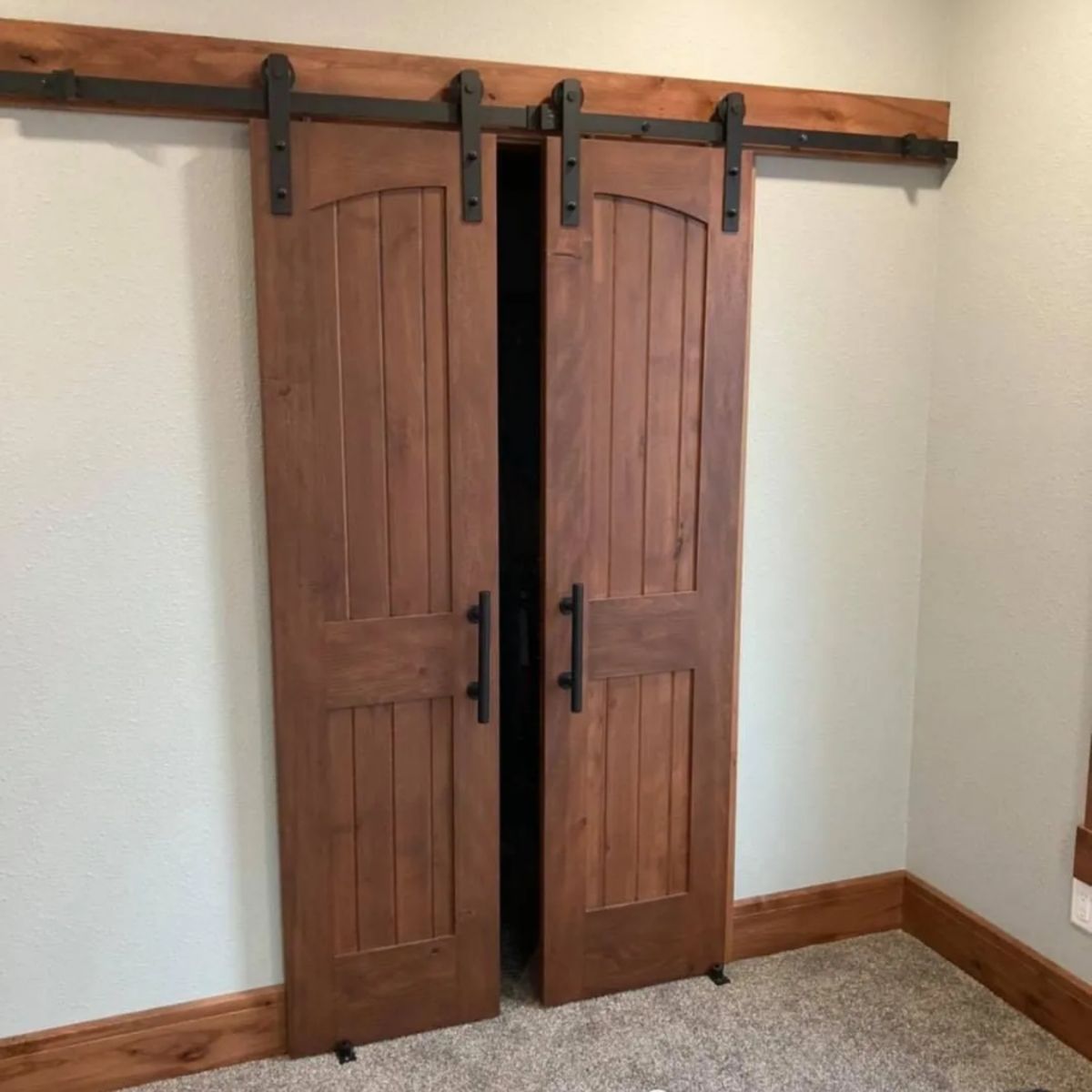
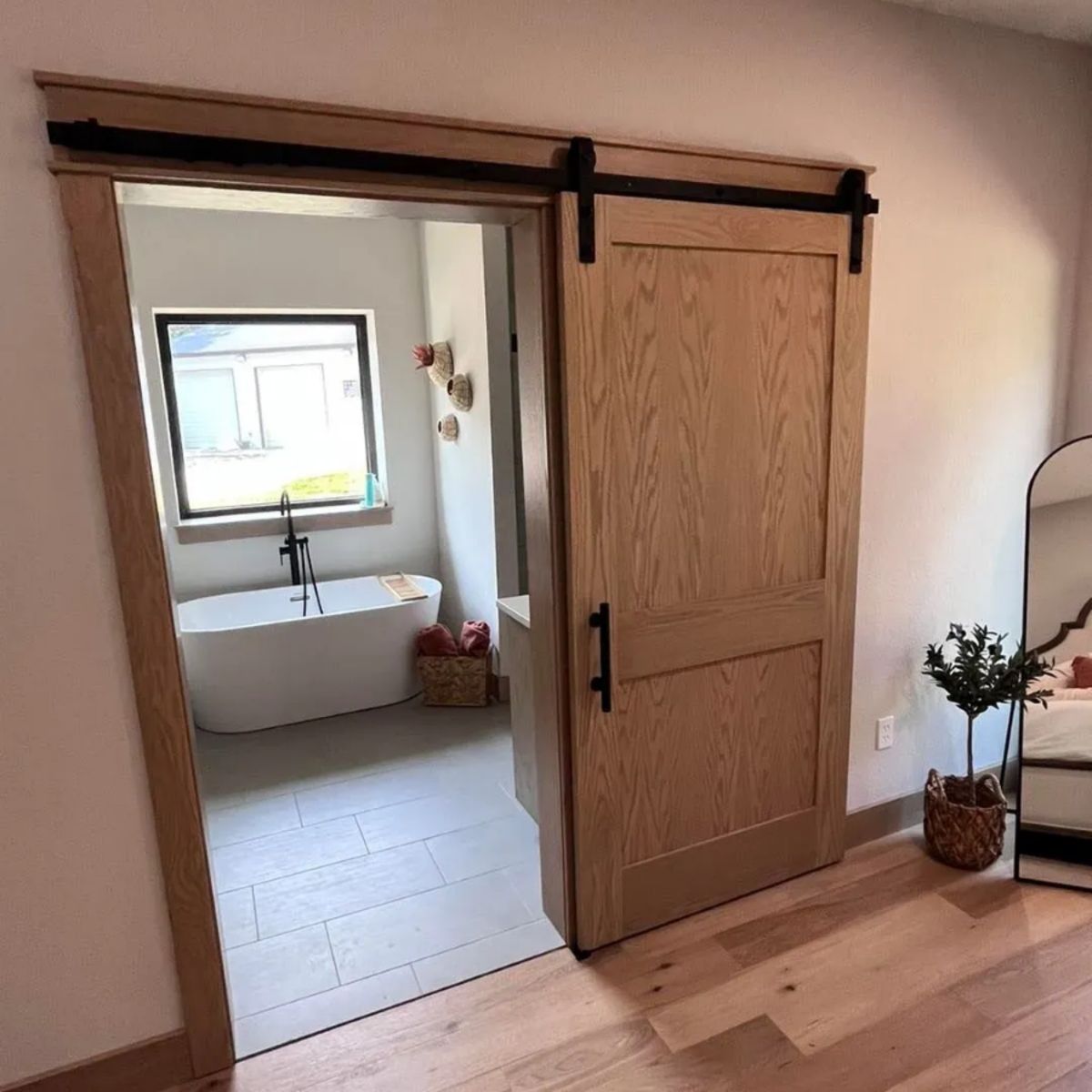
Custom sliding doors, including barn door configurations and bypass systems, solve this problem without sacrificing style. A well-built barn door on a heavy-duty track can serve as a bedroom divider, a laundry room closure, or a pantry door that adds visual character to a kitchen rather than hiding in the background.


The difference between a quality custom sliding door and a cheap hardware store option comes down to the wood and the hardware. Thin, poorly dried wood warps on a track. Lightweight hardware flexes under a solid wood panel and eventually fails. A door built from properly dried, kiln-stable stock and hung on industrial-rated hardware will operate smoothly for decades without adjustment.


What to Ask Before You Commit to Any Door Manufacturer

Before signing off on any door order, whether custom or semi-custom, these are the questions that separate a confident purchase from an expensive regret:

Is it solid wood or engineered? Get this in writing. Many doors marketed as "wood" use MDF cores with a thin veneer face. Ask what the stile, rail, and panel construction actually consists of.


Where is the finish applied? On-site finishing and shop finishing are not the same product. Ask whether the doors arrive pre-finished or raw.


What hardware standards are built in? Hinge placements, lock bore locations, and strike plate sizing all need to match your hardware. A custom door shop should be able to accommodate your specific hardware spec.


Can they match existing profiles? If you have existing trim or casings in your home, your door casing should match. A shop with in-house milling capability, like the trim profile work done at Prairie Winds, can replicate historical profiles and custom shapes that stock suppliers cannot touch.


Who handles installation? The best door in the world hangs poorly when installed by someone unfamiliar with the product. Start-to-finish accountability, from design through installation, matters.


Frequently Asked Questions


How long does a custom interior door project typically take?

Lead times for custom wood doors vary by shop workload and project complexity, but most residential projects in the Kansas City area run between four and eight weeks from design approval to installation. More complex projects involving multiple doors, custom profiles, or matched millwork may take longer. Getting into the queue early during a remodel is always the right move.

Are custom interior doors significantly more expensive than stock doors?

The upfront cost is higher, but the comparison is not straightforward. Stock doors often require additional labor for fitting, on-site finishing, and eventual replacement. A solid wood custom door, properly finished and installed, can last the life of the home. When you factor in the absence of painting costs, the elimination of callback work, and the longevity of the product, the total cost over time is frequently comparable, and the result is dramatically better.

Can custom doors be made to match older homes with non-standard openings?

Yes, and this is one of the primary reasons Kansas City homeowners in older neighborhoods choose custom over stock. Pre-war homes in areas like Brookside, Waldo, and the surrounding Johnson County suburbs regularly have openings that fall outside modern standard dimensions. A custom door is built to your exact rough opening size with no compromise.

What wood species holds up best in Kansas City's humidity?

Kansas City sits in a climate zone where summer humidity can be high and winters are dry. Species with moderate density and good dimensional stability, like oak and hard maple, tend to perform well here. Proper kiln drying and a quality conversion varnish finish also play a major role in minimizing seasonal movement, regardless of species.

Do custom interior doors add to home resale value?

Real wood custom doors are consistently flagged by buyers and appraisers as a quality indicator. In a competitive Kansas City market, homes with custom millwork and doors command more attention and tend to hold their value better than homes finished with builder-grade materials. The exact return varies by neighborhood and price point, but the presence of real wood craftsmanship is rarely a negative.


The Bottom Line

Interior doors touch every room in your home. They are one of the few elements that every person in the house interacts with dozens of times a day. Choosing real wood, custom-built doors means choosing something that fits properly, finishes cleanly, and holds up for as long as you own the home.


For homeowners and contractors across Kansas City, Overland Park, Leawood, and Olathe who are ready to stop compromising on the details, Prairie Winds Woodworking builds custom interior and exterior doors from solid wood, finishes them in-house, and installs them with the same precision that goes into every other part of the project. Get in touch to start the conversation about what your space needs.


Share this article

Recent Posts

By Wyan Bowman May 19, 2026
If you've ever replaced kitchen cabinets after just a few years, there's a good chance they weren't made from real wood. Melamine and particle board dominate the mass-market cabinet industry because they're cheap to produce and easy to ship. But they come with a shelf life. Real wood cabinets, when built and finished correctly, can last decades without warping, swelling, or falling apart at the joints. This guide breaks down why that difference exists, what actually happens to low-grade materials over time, and what to look for when investing in cabinetry that holds up. What Are Melamine and Particle Board, Really? Melamine and particle board are not the same thing, though they're often used together. Particle board is the base material, made from compressed wood chips, sawdust, and resin. Melamine is a paper or film laminate that's heat-pressed onto the surface to give it a finished look. Medium-density fiberboard (MDF) follows a similar concept, using finer wood fibers compressed under pressure. These materials aren't worthless. In some commercial or temporary applications, they serve a purpose. But they have three fundamental weaknesses that show up quickly in a home kitchen or bathroom environment: they absorb moisture, they don't hold fasteners well over time, and they can't be refinished. What Happens When Moisture Gets In? Real kitchens and bathrooms are humid. Steam from cooking, splashes near the sink, and humidity changes through the seasons all affect cabinetry. This is where particle board and melamine start to fail. When moisture reaches the core of particle board, the compressed wood fibers begin to swell. That swelling causes the laminate surface to bubble or crack. Once that happens, the damage is permanent. The cabinet box won't return to its original shape, and there's no practical way to repair it. You're looking at a full replacement. Real wood handles moisture differently. It does expand and contract with humidity changes, which is why proper finishing matters so much. A water-resistant coating applied correctly seals the wood and dramatically slows moisture absorption. The key phrase there is "applied correctly." Spray-applied industrial finishes like M.L. Campbell conversion varnish, which the team at Prairie Winds Woodworking uses on every cabinet they build, create a much harder, more durable surface than brush-on paints or basic sealers. That finish layer is what gives real wood its edge in wet environments. Do Fasteners Actually Matter That Much? More than most homeowners realize. Cabinet boxes take a beating over time. Hinges are opened and closed thousands of times. Drawer slides carry weight daily. Shelves hold heavy dishes and appliances for years. All of those loads transfer into the cabinet material through screws and fasteners. Particle board has one well-known weakness: it strips. Screws driven into particle board are gripping compressed sawdust. Over time, especially with repeated stress, that grip loosens. Hinges begin to pull away from the box. Drawer slides start to wobble. The structural integrity of the cabinet slowly degrades even if the surface still looks fine. Real wood grips screws the way wood is designed to. The cellular structure of solid lumber holds fasteners far more effectively. This is why custom cabinets built from real wood with quality hardware like Blum soft-close hinges and slides perform reliably for decades, while a mass-market cabinet from a box store might start showing hardware issues within five to seven years. Can You Tell the Difference Just by Looking? Sometimes, but not always. Manufacturers have gotten good at making melamine surfaces look convincing in a showroom. Here's what to look for beyond the surface:
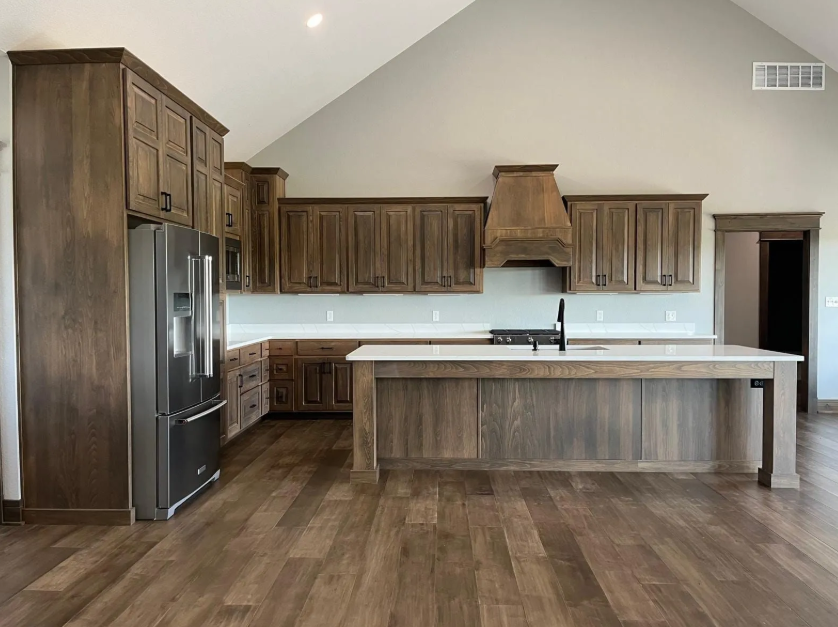
Custom wood kitchen cabinets with water-resistant conversion varnish finish by Prairie Winds
By Wyan Bowman May 8, 2026
Learn how water-resistant finishes protect wood cabinets in kitchens and bathrooms, and why conversion varnish outperforms standard paint for long-term durability.
Custom wood cabinets Lenexa KS kitchen design Prairie Winds Woodworking premium cabinetry
April 30, 2026
Looking for wood cabinets in Lenexa, KS? Explore styles, materials, and expert craftsmanship from Prairie Winds Woodworking for your dream kitchen.
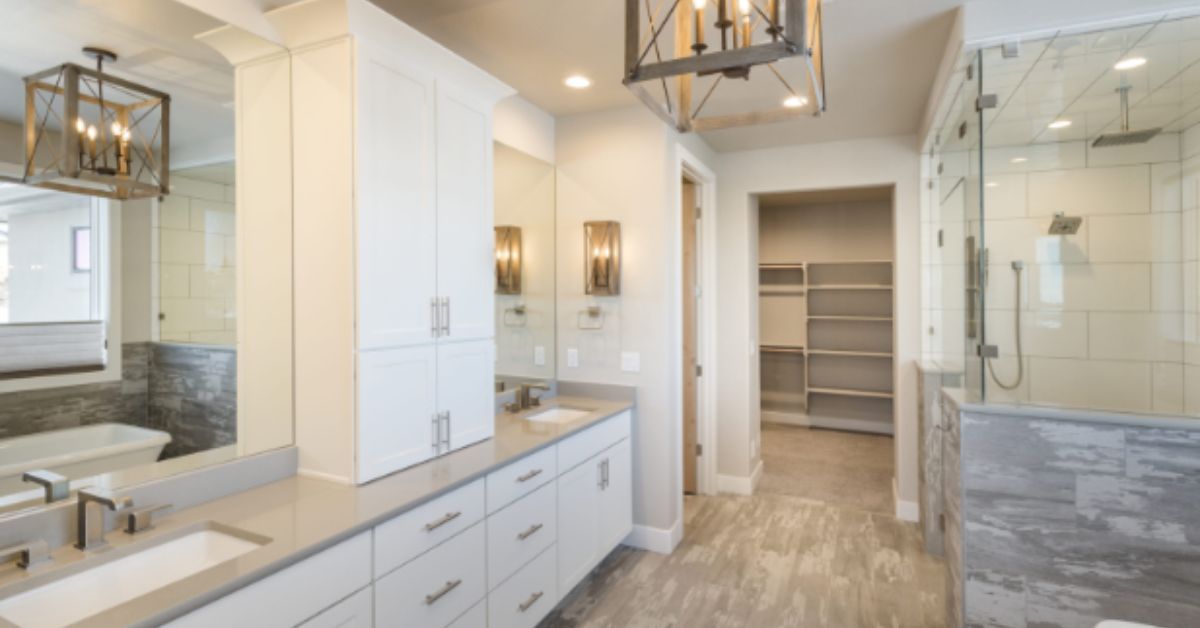
Bathroom cabinet makers, Kansas City, KS, custom vanity Prairie Winds Woodworking
April 30, 2026
Discover bathroom cabinet makers in Kansas City, KS. Prairie Winds Woodworking creates custom storage solutions tailored to your home. Call today!
Luxury kitchen cabinets Leawood, KS, modern design Prairie Winds Woodworking
April 30, 2026
Upgrade your space with luxury kitchen cabinets in Leawood, KS. Prairie Winds Woodworking offers high-end cabinets in Kansas City, KS, with expert installation.
Promotional graphic for Prairie Winds Woodworking featuring a modern floating wood bathroom vanity w
By Wyan Bowman March 2, 2026
Discover how a custom wood vanity can maximize bathroom storage with smart drawer configurations, durable materials, and tailored design.
Custom architectural millwork with arched openings and built-in cabinetry
By Wyan Bowman February 4, 2026
Learn how custom architectural millwork brings structure, flow, and long-term value to residential spaces through thoughtful design and expert craftsmanship.
Custom wooden kitchen island with matching cabinetry in a Kansas City home
By Wyan Bowman January 26, 2026
Learn how a custom kitchen island can be designed to fit your space, support daily routines, and stay useful as your needs change over time.
Custom wood doors in Kansas City, KS handcrafted by Prairie Winds Woodworking
January 23, 2026
Custom Wood Doors Kansas City, KS crafted for beauty, durability, and energy efficiency. Trust Prairie Winds Woodworking—book a free consultation today.
High-end custom cabinets handcrafted by Prairie Winds Woodworking in Kansas City, KS
January 2, 2026
Explore high-end cabinets in Kansas City, KS. Learn what sets premium cabinetry apart and why Prairie Winds Woodworking is trusted for custom craftsmanship. Primary Keyword: High-End Cabinets Kansas City, KS Secondary Keywords: Custom wood doors, Custom Interior & exterior doors