
What Makes Luxury Kitchen Cabinets Custom? 9 Details

Wyan Bowman • September 4, 2026

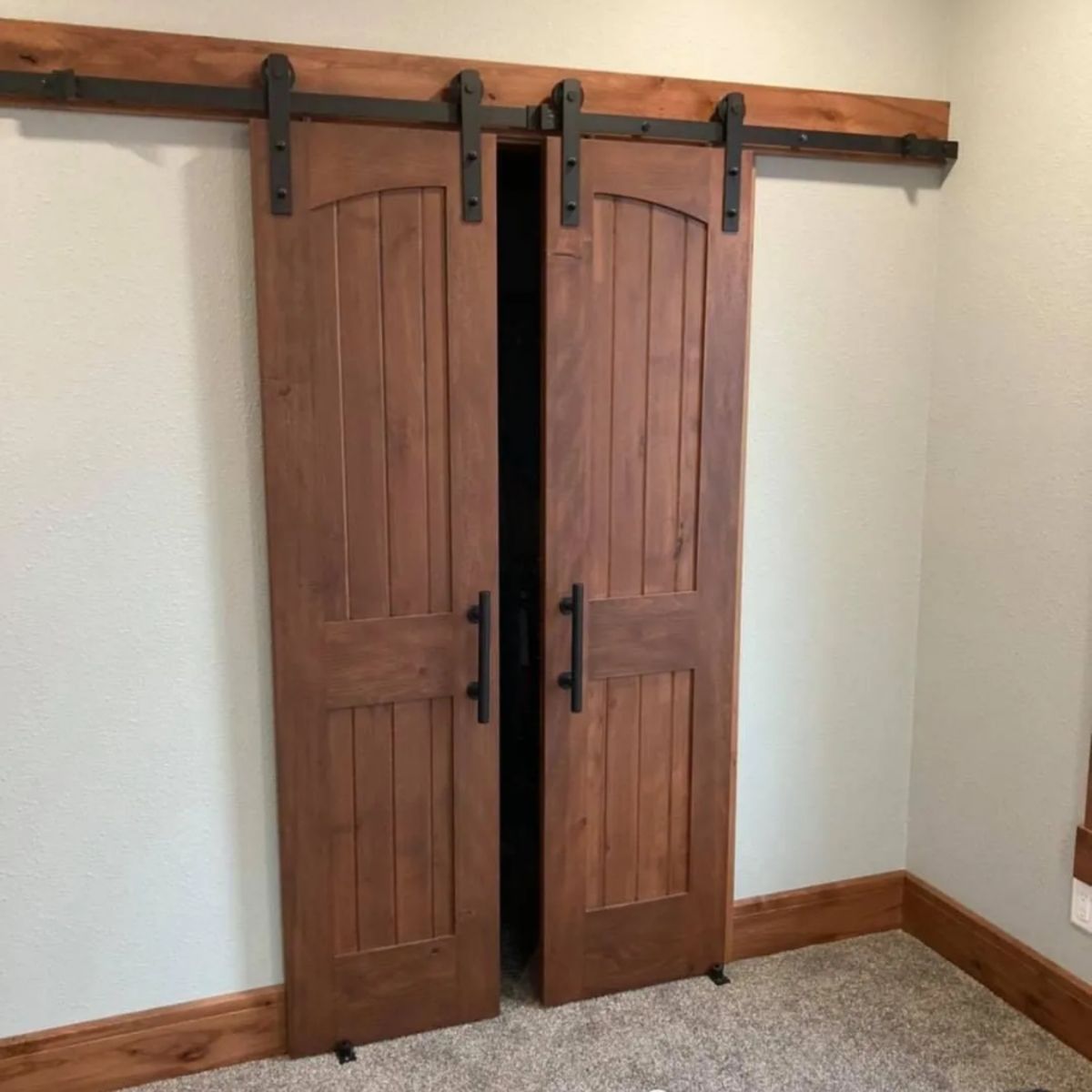
Sliding barn doors do not seal as tightly as traditional doors, so they offer less insulation against drafts and temperature changes. This makes them better suited to interior rooms rather than doorways leading to unconditioned spaces like garages.

Sliding barn doors have moved beyond the farmhouse trend and into modern and transitional design, especially in flush-panel styles with metal accents. They remain a popular functional choice for tight spaces, so they are more likely to keep evolving in style than disappear.

An existing panel door can sometimes be converted, but it usually requires modification since barn doors hang several inches off the floor while panel doors sit flush against it. In many cases, building a new door sized correctly for barn door hardware gives a cleaner result than converting an old one.

A sliding barn door needs clear wall space equal to the full width of the door opening, with no outlets, switches, or fixtures in that path. A standard 36-inch door needs roughly 36 inches of unobstructed wall to slide open completely.

Neither door style has been shown to significantly increase home resale value on its own. Quality craftsmanship and consistent design choices throughout the home matter more to buyers than whether a specific door slides or swings.

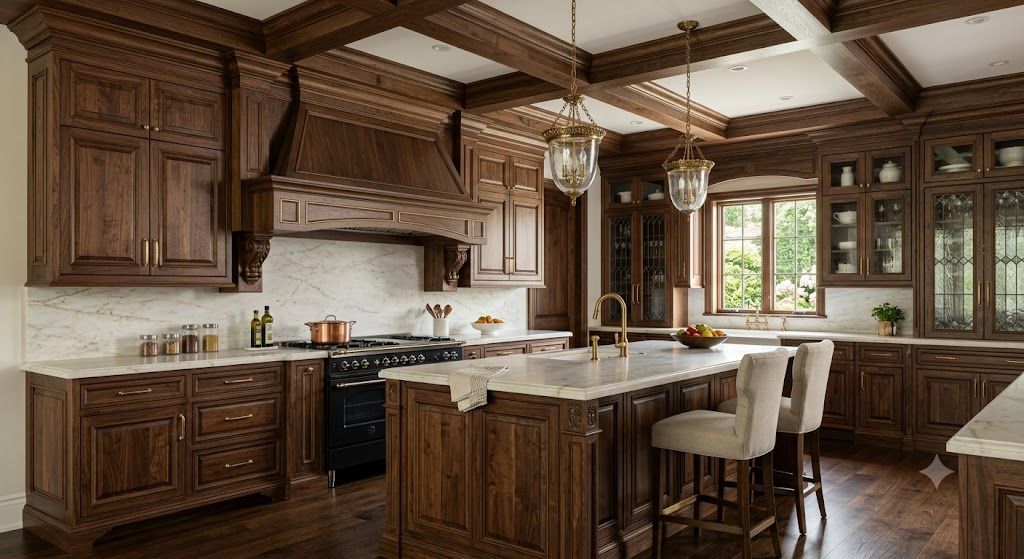
A truly custom luxury kitchen cabinet is designed and built around the homeowner’s space, storage needs, style, and daily routines. It is not simply a higher-priced version of a stock cabinet. True custom work involves precise measurements, made-to-order dimensions, carefully selected materials, tailored storage, custom finishes, and professional installation.

For homeowners planning a high-end kitchen in Overland Park, Leawood, Olathe, or the greater Kansas City area, knowing what to look for can prevent an expensive mistake. A beautiful cabinet can still be poorly suited to a room if it was not designed for the way the kitchen will actually be used.


1. Exact Measurements For The Actual Room


A custom cabinet should be measured for the specific kitchen, not selected from a fixed set of standard sizes. The cabinet maker should account for wall lengths, ceiling height, windows, doors, plumbing, electrical locations, appliances, and even small variations in the room itself.


This level of measurement matters because homes are rarely perfectly square. A wall may be slightly out of alignment, a floor may have a small slope, or an older home may have irregular corners. Stock cabinets often require filler pieces to handle these conditions. Custom cabinets can be built to fit the available space more precisely.


Before construction begins, homeowners should expect detailed site measurements and a review of appliance specifications. A professional cabinet maker may also identify clearance issues that are easy to miss on a basic kitchen plan.


2. Cabinets Built Around How You Use The Kitchen

The best custom kitchen cabinet design starts with function. Instead of asking only what the cabinets should look like, a good designer asks what you store, how you cook, which appliances you use most, and what causes frustration in your current kitchen.


That can lead to details such as a narrow pullout for baking sheets, a deep drawer for pots, a dedicated spice area near the cooktop, or storage sized around a stand mixer. A coffee station can be designed around the height of the machine and the location of electrical outlets.


Custom storage is also useful for awkward areas. Rather than leaving a corner cabinet difficult to reach, the design can incorporate drawers, specialty shelving, or another solution suited to the space.


The goal is not to fill every inch with cabinetry. It is to make the available storage easier to access and better suited to the homeowner.


3. Real Wood And Carefully Chosen Materials


Material selection is one of the clearest differences between luxury custom cabinetry and lower-cost cabinet construction. Homeowners should ask exactly what materials are used for the cabinet boxes, doors, drawer fronts, shelves, and trim.


The wood species also affects the final appearance. Oak, maple, cherry, walnut, and other species each have different grain patterns, colors, and characteristics. The right choice depends on the desired design and finish, not just the price of the material.


Ask about material thickness, joinery, drawer construction, shelf support, and hardware as well. A luxury cabinet should be judged by what is inside the cabinet as much as what can be seen from across the room.


4. Proportions Designed For The Architecture


Custom cabinetry should look like it belongs to the house. That requires more than choosing a door style from a catalog.


Cabinet height, width, trim, rails, stiles, panel sizes, and spacing can all be adjusted to create balanced proportions. In a home with tall ceilings, cabinets may be designed to reach higher instead of stopping well below the ceiling and leaving an awkward gap.


Architectural details can also tie the kitchen to the rest of the home. Crown moulding, furniture-style end panels, decorative legs, matching trim, and carefully designed transitions can make the cabinetry feel like part of the architecture.


This is especially valuable in luxury homes where the kitchen is visible from dining rooms, living areas, or entry spaces. The cabinetry should work with those rooms rather than looking like a separate installation.


5. A Finish That Matches The Design And Holds Up


A custom cabinet finish should do two jobs: create the desired appearance and provide protection for everyday use. Kitchens face moisture, food spills, heat, fingerprints, and frequent cleaning, so finish selection deserves careful attention.


Homeowners should ask whether cabinets are finished in a controlled shop environment and what protective coating is being used. Shop finishing can provide better control over dust, temperature, and application than finishing large pieces inside a finished home.


Prairie Winds Woodworking pre-finishes its custom woodwork in its shop and uses water-resistant coatings on its luxury kitchen cabinets. This approach also means the installation does not depend on on-site painting or caulking to complete the finished appearance.


A custom finish can also go beyond a basic stain or paint color. Sheen, color variation, wood grain, and the way the finish interacts with surrounding materials all affect the final result.


6. Hardware Chosen For The Cabinet, Not Added As An Afterthought


Hinges, drawer slides, pulls, knobs, and specialty hardware may seem like small details, but they have a direct effect on how a kitchen feels every day.


Quality hardware should match the weight and intended use of each cabinet. Large drawers carrying cookware need hardware designed for heavier loads. Frequently used doors benefit from dependable hinges and proper adjustment.


Hardware placement matters, too. A pull positioned for comfortable use may work better than one chosen only for visual symmetry. The same principle applies to appliance garages, pantry doors, trash pullouts, and other specialized sections.


A cabinet can look expensive in a photograph and still feel disappointing if the doors sag, drawers bind, or storage accessories are poorly fitted. Custom cabinetry should treat these working parts as part of the design.


7. Details That Make The Cabinet Look Like Furniture


Luxury cabinetry often borrows techniques from furniture making. Finished ends, inset details, carefully matched grain, shaped panels, decorative feet, and integrated trim can give cabinets a more substantial appearance.


These details are especially useful on islands and exposed cabinet ends. Those surfaces are visible from multiple directions, so unfinished or generic side panels can stand out.


Furniture-style cabinetry also allows the kitchen to move away from a purely utilitarian appearance. An island can be designed as a central architectural feature, while a tall cabinet wall can resemble built-in furniture rather than a row of boxes.


The key is restraint. Custom does not mean adding decoration everywhere. Good craftsmanship uses details where they support the architecture and overall design.

8. Precision Installation Is Part Of The Craft


A cabinet is only as good as the installation. Even well-built pieces can look wrong when they are poorly leveled, misaligned, or fitted without enough attention to surrounding surfaces.


Professional installation should include careful leveling, alignment, spacing, appliance coordination, and adjustments after the cabinets are positioned. Small gaps and inconsistent reveals can become very noticeable in a high-end kitchen.


Installation also needs to account for the finished floor, countertops, backsplash, lighting, appliances, and nearby millwork. These elements meet at the cabinet, so coordination matters.


Prairie Winds Woodworking handles professional installation as part of its custom woodworking process. For homeowners in the Kansas City metro, keeping fabrication and installation under one team can simplify communication and reduce the risk of details being lost between separate contractors.


9. One Team Taking Responsibility From Design Through Installation


The strongest sign of truly custom work is often the process behind it. Homeowners should know who measures the space, who builds the cabinets, who applies the finish, and who installs the finished pieces.


When those steps are handled by disconnected companies, changes can create communication problems. A measurement issue discovered during installation may lead to delays or costly modifications.


An in-house process gives the cabinet maker greater control over the finished product. Prairie Winds Woodworking designs, builds, pre-finishes, and installs its custom woodworking in-house. The company has served homeowners and residential contractors throughout Kansas City, including Leawood, Overland Park, Olathe, Lenexa, and Mission, since 2014.


That matters because custom cabinetry is a chain of connected decisions. The quality of the final kitchen depends on each stage being handled with care.


People Also Ask

What Is The Difference Between Custom And Semi-Custom Kitchen Cabinets?

Are Custom Kitchen Cabinets Made From Real Wood?

How Long Do Luxury Custom Cabinets Last?

Should Cabinets Be Installed Before Or After Flooring?

Are Custom Cabinets Worth The Cost?
The Custom Standard To Look For

A luxury kitchen cabinet should offer more than an attractive door and a premium price tag. Look for precise measurements, real materials, tailored storage, balanced proportions, durable finishes, quality hardware, furniture-level details, careful installation, and a team that takes responsibility for the complete process.


For homeowners planning a custom kitchen in Kansas City, these details make it easier to compare cabinet makers based on craftsmanship rather than appearance alone.


Prairie Winds Woodworking creates custom luxury kitchen cabinets with real wood, in-house fabrication, shop-applied finishes, and professional installation for homeowners throughout the Kansas City metro. Contact us to discuss custom cabinetry designed around your home, your storage needs, and the way you use your kitchen.


Share this article

Recent Posts

Double solid wood sliding barn doors mounted on black metal track hardware, creating a space-saving
By Wyan Bowman • July 15, 2026
Weighing sliding barn doors against traditional doors for your Kansas City home? See where a barn door is worth the investment and where it's not.
Custom Sliding Doors Leawood, KS handcrafted wood sliding door installed by Prairie Winds Woodwork
June 15, 2026
Discover why homeowners choose Custom Sliding Doors Leawood, KS for modern living. Prairie Winds Woodworking creates handcrafted wood doors. Call 785-893-2148
Custom solid wood interior door with natural stain finish installed in a Kansas City home
By Wyan Bowman • June 12, 2026
Solid wood custom interior doors offer better fit, finish, and longevity than stock options. Here's what Kansas City homeowners need to know before they buy.
By Wyan Bowman • May 19, 2026
If you've ever replaced kitchen cabinets after just a few years, there's a good chance they weren't made from real wood. Melamine and particle board dominate the mass-market cabinet industry because they're cheap to produce and easy to ship. But they come with a shelf life. Real wood cabinets, when built and finished correctly, can last decades without warping, swelling, or falling apart at the joints. This guide breaks down why that difference exists, what actually happens to low-grade materials over time, and what to look for when investing in cabinetry that holds up. What Are Melamine and Particle Board, Really? Melamine and particle board are not the same thing, though they're often used together. Particle board is the base material, made from compressed wood chips, sawdust, and resin. Melamine is a paper or film laminate that's heat-pressed onto the surface to give it a finished look. Medium-density fiberboard (MDF) follows a similar concept, using finer wood fibers compressed under pressure. These materials aren't worthless. In some commercial or temporary applications, they serve a purpose. But they have three fundamental weaknesses that show up quickly in a home kitchen or bathroom environment: they absorb moisture, they don't hold fasteners well over time, and they can't be refinished. What Happens When Moisture Gets In? Real kitchens and bathrooms are humid. Steam from cooking, splashes near the sink, and humidity changes through the seasons all affect cabinetry. This is where particle board and melamine start to fail. When moisture reaches the core of particle board, the compressed wood fibers begin to swell. That swelling causes the laminate surface to bubble or crack. Once that happens, the damage is permanent. The cabinet box won't return to its original shape, and there's no practical way to repair it. You're looking at a full replacement. Real wood handles moisture differently. It does expand and contract with humidity changes, which is why proper finishing matters so much. A water-resistant coating applied correctly seals the wood and dramatically slows moisture absorption. The key phrase there is "applied correctly." Spray-applied industrial finishes like M.L. Campbell conversion varnish, which the team at Prairie Winds Woodworking uses on every cabinet they build, create a much harder, more durable surface than brush-on paints or basic sealers. That finish layer is what gives real wood its edge in wet environments. Do Fasteners Actually Matter That Much? More than most homeowners realize. Cabinet boxes take a beating over time. Hinges are opened and closed thousands of times. Drawer slides carry weight daily. Shelves hold heavy dishes and appliances for years. All of those loads transfer into the cabinet material through screws and fasteners. Particle board has one well-known weakness: it strips. Screws driven into particle board are gripping compressed sawdust. Over time, especially with repeated stress, that grip loosens. Hinges begin to pull away from the box. Drawer slides start to wobble. The structural integrity of the cabinet slowly degrades even if the surface still looks fine. Real wood grips screws the way wood is designed to. The cellular structure of solid lumber holds fasteners far more effectively. This is why custom cabinets built from real wood with quality hardware like Blum soft-close hinges and slides perform reliably for decades, while a mass-market cabinet from a box store might start showing hardware issues within five to seven years. Can You Tell the Difference Just by Looking? Sometimes, but not always. Manufacturers have gotten good at making melamine surfaces look convincing in a showroom. Here's what to look for beyond the surface:
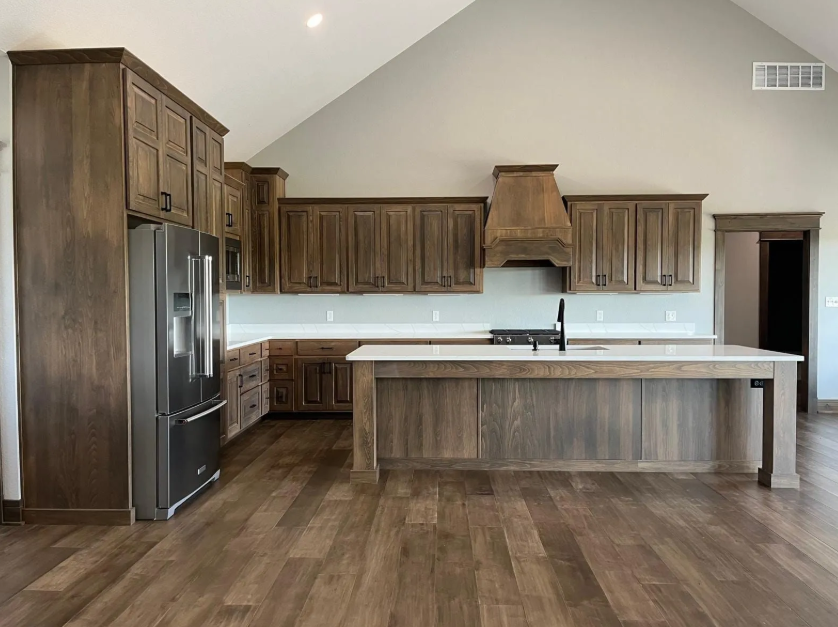
Custom wood kitchen cabinets with water-resistant conversion varnish finish by Prairie Winds
By Wyan Bowman • May 8, 2026
Learn how water-resistant finishes protect wood cabinets in kitchens and bathrooms, and why conversion varnish outperforms standard paint for long-term durability.
Custom wood cabinets Lenexa KS kitchen design Prairie Winds Woodworking premium cabinetry
April 30, 2026
Looking for wood cabinets in Lenexa, KS? Explore styles, materials, and expert craftsmanship from Prairie Winds Woodworking for your dream kitchen.
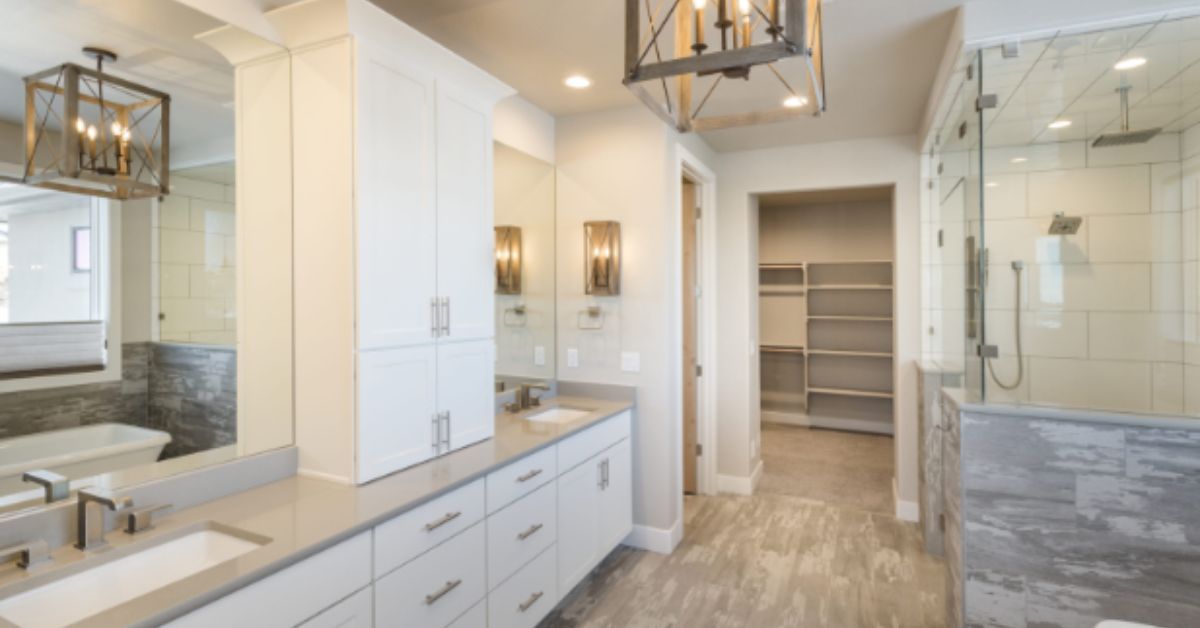
Bathroom cabinet makers, Kansas City, KS, custom vanity Prairie Winds Woodworking
April 30, 2026
Discover bathroom cabinet makers in Kansas City, KS. Prairie Winds Woodworking creates custom storage solutions tailored to your home. Call today!
Luxury kitchen cabinets Leawood, KS, modern design Prairie Winds Woodworking
April 30, 2026
Upgrade your space with luxury kitchen cabinets in Leawood, KS. Prairie Winds Woodworking offers high-end cabinets in Kansas City, KS, with expert installation.
Promotional graphic for Prairie Winds Woodworking featuring a modern floating wood bathroom vanity w
By Wyan Bowman • March 2, 2026
Discover how a custom wood vanity can maximize bathroom storage with smart drawer configurations, durable materials, and tailored design.
Custom architectural millwork with arched openings and built-in cabinetry
By Wyan Bowman • February 4, 2026
Learn how custom architectural millwork brings structure, flow, and long-term value to residential spaces through thoughtful design and expert craftsmanship.
Show More